Your Cracked Violin Bridge: What to Do Next
You noticed it this morning, or perhaps your teacher pointed it out, or you heard something shift in the instrument's response and looked more carefully than usual. There is a crack in your violin bridge. Before you tune the strings or pack the case for rehearsal, there are a few things worth understanding.
The Bridge Is Not a Simple Piece of Wood
Every serious player knows the bridge transfers energy from the strings to the instrument's body. What is less often said is that the bridge does not merely transmit vibration. It shapes it. The fit of the feet against the top, the height and curvature of the arch, the precise thinning of the wood toward the upper edge, the angle at which it stands: each of these decisions affects how freely the instrument responds under the bow, how the tone projects across a hall, and how much resistance or ease a player feels in the softer dynamics.
A bridge that is cracked, poorly fitted, or allowed to lean forward over time is not a neutral presence in the instrument's voice. It is an active interference.
When a bridge develops a crack, even a hairline one through the grain, its ability to transmit string energy evenly is compromised. The two halves of the bridge no longer behave as a single tuned element. What you hear as a slight deadening of tone, a loss of focus in the upper register, or a new roughness in the response is often the sound of that interference. Players sometimes spend months adjusting strings or bow technique before someone looks at the bridge.
What a Cracked Bridge Actually Means
Not every crack is the same. A fine surface check in the varnish near the top of the bridge is different from a crack running through the grain between the feet. A bridge that has tipped forward over years of tuning is different from one that has split under sudden string tension. The correct response, whether to reshape and refit the existing bridge or to fit a new one, depends entirely on where the crack runs, how deep it goes, and whether the structural integrity of the feet and waist has been affected.
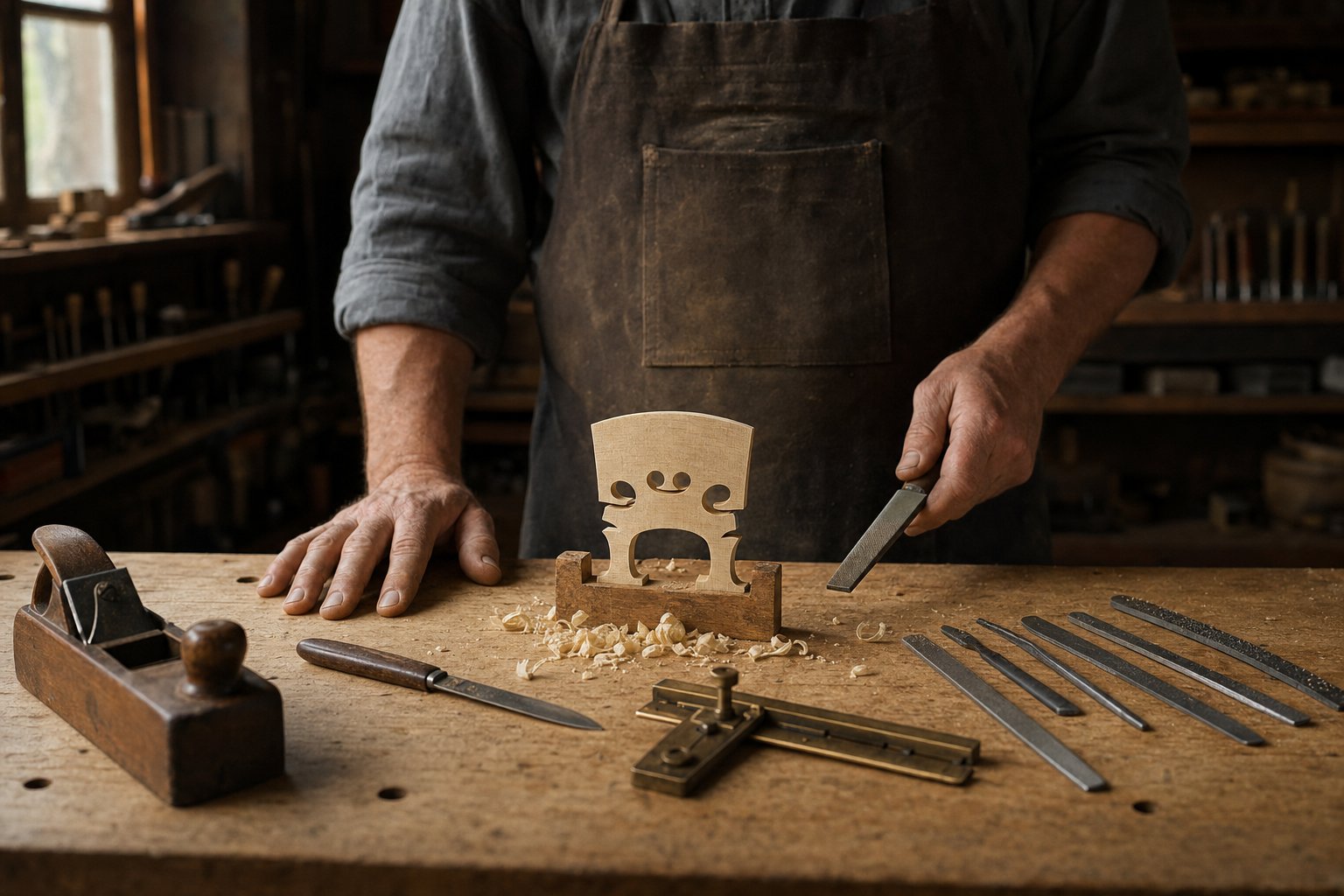
This is why self-repair is a risk worth naming plainly. Household wood adhesives, including the ones marketed as suitable for fine woodwork, are not appropriate for a violin bridge. They introduce rigidity at a joint that is designed to transmit vibration, and they can make a professional repair significantly more difficult. If the bridge fails completely under string tension, the sudden release can pull the top, shift the soundpost, or cause an open seam. A cracked bridge is worth taking seriously before it becomes a more complicated problem.
What to Do Before You Bring the Violin In
If the bridge is visibly cracked or leaning badly, loosen the strings slightly to reduce tension. Do not remove all the strings at once unless a qualified luthier has advised you to, because the soundpost inside the instrument is held in position by string pressure, and removing that pressure can allow it to fall. Keep the instrument in its case, protected from sudden changes in temperature or humidity, and photograph the bridge and its current position before transport. That photograph gives a luthier useful information about how the bridge has been sitting.
Do not play on a bridge you know is compromised. The risk is not only to the bridge itself. A bridge that fails under playing conditions can cause damage to the top of the instrument that is considerably more involved to address.
Repair or Replacement: How a Luthier Decides
A professional inspection is the only way to determine which path is right for your instrument. A luthier assessing a cracked bridge is looking at more than the crack. They are considering whether the feet are correctly fitted to the top, whether the bridge has warped or shifted from its correct position, whether the soundpost needs attention, and whether the instrument's overall setup is serving the player's needs or working against them.
A bridge repair done by someone thinking only about structure, and not about what the instrument is acoustically capable of, can fix the crack and still leave the instrument sounding less than it should.
In many cases, fitting a new bridge is the more appropriate solution. A well-fitted bridge, cut and adjusted for a specific instrument and a specific player, does something a patched one rarely does: it gives the luthier the opportunity to reconsider the setup from the ground up. Height, string spacing, the precise graduation of the wood toward the upper edge, all of these are decisions that affect tonal response, and a new bridge is a chance to get them right for how you actually play.
Why the Maker's Perspective Matters in a Repair
Hermann Janzen's Mission, BC workshop handles bridge fitting and structural repair as part of a broader approach to setup and restoration for violin, viola, and cello. The distinction worth drawing is between a technician who repairs what is broken and a luthier who thinks about what the instrument is meant to do.
The Janzen Sound, the tonal philosophy that guides every instrument Hermann builds, is centered on resonance, response, and expressive depth. Those same principles apply to how a repair is approached. A bridge is not simply a mechanical component to be replaced. It is part of a system, and a luthier who understands how that system works, who has spent years building instruments from the first cut of wood to the final setup, brings a different quality of attention to a repair than someone who has not.
The direct maker-to-player relationship that defines the Janzen workshop means that when you bring your instrument in, you are talking to the person doing the work. Not a service desk, not a shop assistant. Hermann. That conversation is part of what the repair is, because understanding how you play, what repertoire you are preparing for, and what the instrument currently feels like under your bow is relevant to how the bridge is fitted and how the setup is adjusted.
Hermann Janzen is listed in The Strad directory, the most authoritative international publication for string players and makers, and his instruments have appeared through Bay Fine Strings, one of Vancouver's most respected dealers of fine instruments. That context matters not as a credential to display but as evidence that the standard being applied to your repair is the same standard applied to instruments that serious players and respected dealers consider worth preserving.
Frequently Asked Questions
Can I keep playing on a cracked bridge? Not without risk. A cracked bridge is structurally compromised and will affect the instrument's tonal response. Playing on it also risks the bridge failing suddenly under string tension, which can cause damage to the top or shift the soundpost. Loosen the strings slightly and contact a luthier before your next rehearsal.
How do I know if my bridge needs to be repaired or replaced? A professional inspection is the only reliable way to determine this. The location and depth of the crack, the condition of the feet, and whether the bridge has warped or tipped all factor into the decision. A luthier assessing the bridge will also consider whether the current setup is serving the instrument well, or whether fitting a new bridge is the opportunity to improve it.
Will a new bridge change how my violin sounds? A well-fitted bridge, cut and adjusted for your specific instrument, can meaningfully improve tonal response, projection, and playability. A poorly fitted one can do the opposite. This is why the quality of the luthier's work and their understanding of the instrument as an acoustic system matters as much as the quality of the bridge blank itself.
How do I get in touch with Janzen Violins in Mission, BC? Hermann Janzen can be reached by phone at 604-807-7153 or by email at ehjanzen@shaw.ca. The workshop is in Mission, British Columbia. It is worth contacting Hermann before bringing the instrument in, so he can prepare for the assessment and give you a clear sense of what to expect.
Is a bridge repair suitable for any violin, or only high-end instruments? A luthier's setup and repair work is appropriate for any instrument that a serious player depends on for performance. The care applied to a bridge fitting is not reserved for expensive instruments. It is simply the correct way to do the work, because a poorly fitted bridge limits any violin, regardless of what it cost.
Bringing It In
If you are in Mission, the Fraser Valley, or anywhere in the Lower Mainland and you are looking at a cracked bridge right now, the next step is a conversation rather than a guess. Hermann Janzen has spent decades thinking about what violins are acoustically capable of, and that perspective is available to you in a single workshop visit.
The fall concert season is close. The time to address what your instrument needs is before the first rehearsal, not after.
Explore The Janzen Sound and arrange a workshop visit