Wrong Varnish Kills Your Violin's Projection
You have tried four bows. You have adjusted your shoulder rest three times. You have moved your sound post. Your teacher says your technique is fine. And still, the violin disappears the moment you step away from the practice room wall.
Most players never consider the varnish.
That is a mistake. Because varnish is not a cosmetic decision. It is an acoustic one, and when it goes wrong, it goes wrong quietly, invisibly, and permanently, unless you know what to look for.
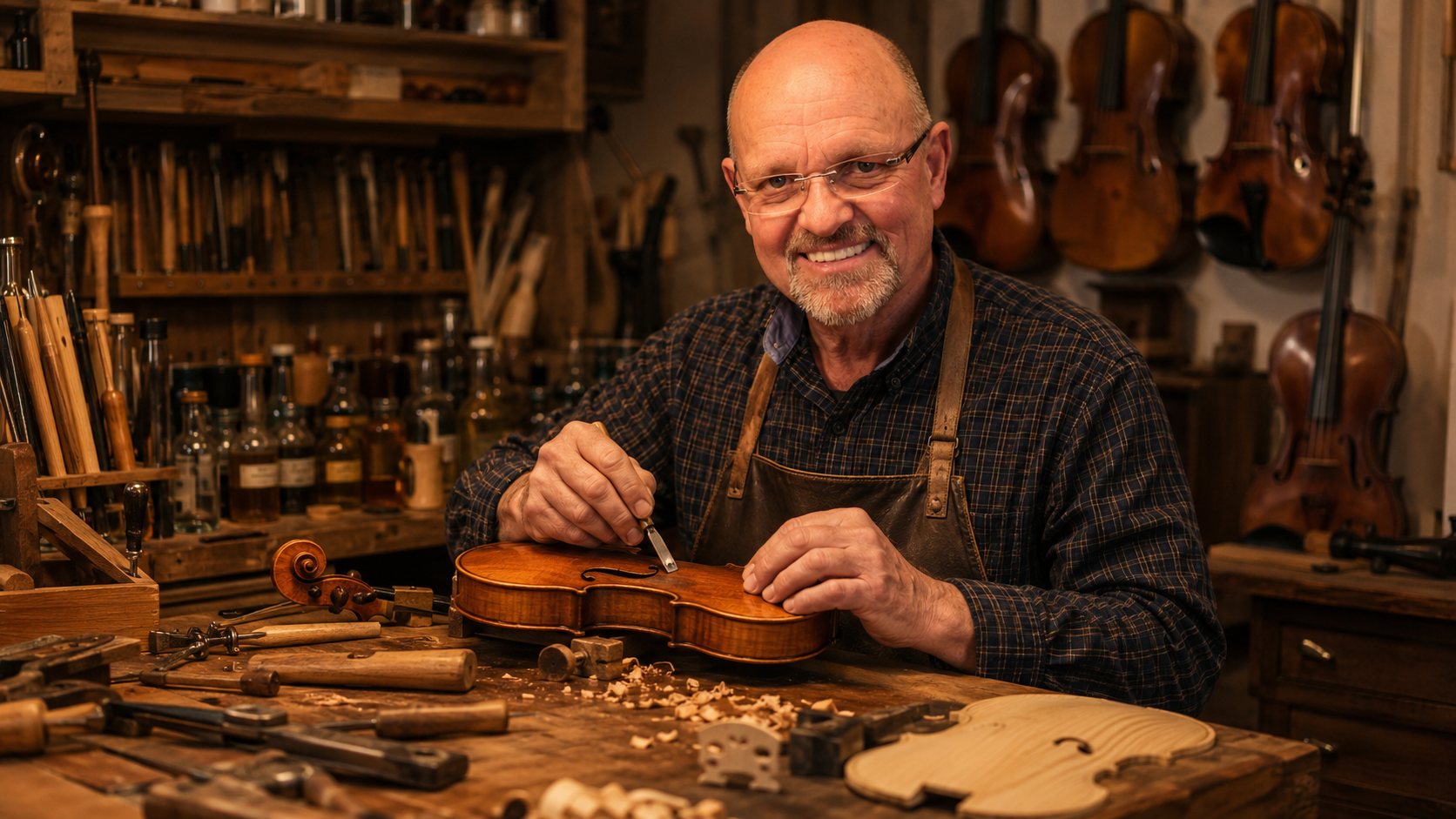
Hermann Janzen has been building handcrafted violins in Mission, BC to the tonal ideals of the great Italian makers for years. Every instrument that leaves his workshop carries varnish that was chosen and applied as deliberately as the wood beneath it. This article is what he knows about what happens when varnish is done wrong, and why it matters to every serious player choosing or commissioning an instrument.
What Varnish Actually Does to a Violin
The wood of a violin top is not a static surface. It vibrates. Every note you play sets the spruce or the maple into motion, and that motion is the sound. The varnish sits on top of that motion and either allows it or resists it.
Think of the top plate as a drumhead. A drumhead with nothing on it vibrates freely. Add a layer of thick, rigid material to the surface and you dampen the response. The fundamental frequencies still come through, but the overtones, the harmonics, and the shimmer that gives a great violin its singing quality are the first things to go.
That is the core acoustic problem with bad varnish. It is not that the violin stops making sound. It is that the violin stops making the right sound. The complex, layered resonance that separates a living instrument from a competent one gets absorbed, flattened, or strangled at the surface before it ever reaches the air.
The Three Most Common Varnish Mistakes
Not all bad varnish looks the same. There are three failure modes that appear most often in production instruments, in workshop violins, and occasionally in the work of makers who prioritized appearance over acoustics.
Mistake One: Varnish That Is Too Thick
This is the most common problem and the hardest to reverse. A varnish layer that is too thick acts as a mechanical damper. The wood wants to move freely in response to the bow. The varnish holds it back. The result is a sound that is full at the fundamental but thin at the top. Projection suffers because projection depends on overtone richness. A violin that sounds warm and present in a small room often disappears in a hall because the overtones that carry across distance have been suppressed.
The great Italian makers applied varnish in extremely thin, layered coats. The total build was measured in fractions of a millimeter. Modern production instruments often apply varnish in a single spray coat for efficiency. The thickness difference is audible.
Mistake Two: Varnish That Is Too Hard
The chemistry of varnish matters as much as its thickness. A varnish that cures to a hard, glass-like film, the kind that looks spectacular under stage lighting, transfers vibration poorly between layers. Hard varnish also tends to crack rather than flex with the wood's seasonal movement, which creates additional acoustic problems over time.
The varnishes associated with the Cremonese tradition were oil-based, flexible, and relatively soft in cure. They moved with the instrument. They aged into the wood rather than sitting on top of it. Makers who use hard lacquers or synthetic sealers for their durability and gloss are solving a different problem than the acoustic one.
Mistake Three: Varnish Applied to Unsealed or Improperly Prepared Wood
Before any varnish goes on, the wood surface needs to be prepared so that the varnish does not soak into the grain. If it does, the varnish becomes structurally part of the wood rather than a surface layer, and the acoustic properties of both are compromised. The wood becomes heavier and stiffer in an uncontrolled way.
Proper ground preparation, the sealing of the wood before varnishing, is one of the most debated topics in lutherie. The Cremonese makers used some form of ground, though exactly what it was remains a subject of research. What is clear is that getting it wrong in either direction, whether too much sealing or too little, changes the acoustic character of the instrument in ways that no amount of post-build adjustment can fully correct.
What Bad Varnish Sounds Like in Practice
Series players describe the effect of a heavily varnished or incorrectly varnished instrument in consistent language, even when they do not know varnish is the cause.
They say the violin sounds muffled. They say it lacks sparkle. They say it projects well in the lower registers but the upper strings feel thin or nasal. They say it sounds better in a small room than on a stage. They say it plays well but has no personality.
That last phrase is the most revealing. Personality in a violin, the sense that the instrument has a voice rather than just a tone, comes from the complexity of its resonance. Varnish that suppresses overtones suppresses personality. The instrument becomes technically functional and expressively flat.
This is one reason why players who have spent time with genuinely great instruments, old Italian instruments, or the best contemporary makers, describe something qualitatively different from what they experience with production violins. It is not myth. It is physics applied with intention.
How Hermann Janzen Approaches Varnish
At the Janzen workshop in Mission, BC, varnish is treated as part of the acoustic system from the first coat. The goal is never appearance alone. The goal is an instrument that embodies what Hermann calls the living voice of music: a tone that is powerful, brilliant, and singing, built to the ideals of the great Cremonese makers.
That means thin, layered application. It means varnish chemistry chosen for flexibility and acoustic transparency rather than durability or visual impact. It means ground preparation that seals the wood without stiffening it. And it means a willingness to spend the time the process requires rather than the time a production schedule allows.
A player who described a Janzen instrument in a professional violin community online used the words powerful and brilliant unprompted. Those are not words that get used about a varnish-dampened instrument. They are words that get used about an instrument where everything, including what is on the surface, was done right.
Why This Matters When You Are Buying or Commissioning
If you are a serious player evaluating instruments in the $10,000 to $30,000 range, varnish is not something most dealers will discuss with you. It is not part of the sales conversation. You are shown the instrument, you play it, you are told it is a fine instrument.
What you are rarely told is what varnish system was used, how thick the build is, whether the ground was applied correctly, or what acoustic tradeoffs were made in the finishing process.
When you work directly with a maker, that conversation is available to you. You can ask. You will get an answer. And the answer tells you something important about whether the maker is building for sound or building for appearance.
That is one of the core differences between commissioning a handcrafted instrument from a single maker like Hermann Janzen and purchasing a production instrument through a dealer: the maker knows every decision that went into the instrument, while the dealer knows the price.
The Long View: How Varnish Ages on a Great Instrument
One of the reasons old Italian instruments sound the way they do is that centuries of playing, of vibration, of seasonal movement, have worked the varnish into a state of equilibrium with the wood beneath it. The varnish has softened, cracked in controlled ways, and partially integrated into the surface. The instrument has become more acoustically transparent over time, not less.
A well-varnished contemporary instrument will age in the same direction. A poorly varnished one will not. Hard lacquers do not soften with age. Thick varnish builds do not become thinner. The acoustic ceiling of a badly varnished instrument is set at the moment of finishing and does not improve.
This is why the instruments that become the great players' lifelong companions are always instruments that were done right from the beginning. The investment is not just in what the violin sounds like today. It is in what it will sound like in twenty years of serious playing.
What to Do With This Information
If you are playing an instrument that plateaus your expression, that disappears in a hall, that sounds fine but has no voice, varnish may not be the only explanation. But it deserves to be part of the conversation.
If you are considering a commission or a significant instrument purchase, ask the maker directly about their varnish process. A maker who cannot answer that question in specific terms is a maker who has not thought about it seriously.
And if you are ready to play an instrument that was built from the wood selection through to the final varnish coat with a single acoustic intention, come to Mission, BC. Play what Hermann Janzen has built. Tell him what you are looking for. That is how this conversation starts.
The living voice of music does not come from the label on the inside. It comes from every decision made on the outside as well.
Inquire about a commission. Tell Hermann about your playing and begin the conversation.
P.S. The players who find the instrument that changes everything are almost never the ones who waited until the timing was perfect. They are the ones who started the conversation.