Why Serious Students Commission Their First Professional Violin
There is a moment every serious violin student knows. You are mid-phrase in a practice room, pushing for something your ears can hear clearly but your hands cannot quite reach. The tone thins. The response lags. The instrument meets you halfway and then stops.
For years, you have told yourself it is your technique. Your bow arm. Your shifting. But somewhere in the back of your mind, a quieter thought has been forming: what if it is the violin?
Graduation season is when that thought finally gets loud enough to act on. And for a growing number of advanced students and young professionals, acting on it does not mean walking into a shop and picking something off the wall. It means calling a maker.
What Changes When You Cross Into Professional Playing
The jump from advanced student to professional performer is not just a change in repertoire or venue. It is a change in what you need from your instrument.
A factory or mid-tier violin is built to a specification. It is voiced to sound acceptable across a wide range of playing styles and room sizes. That breadth is a feature when you are learning. It forgives inconsistency. It rounds off the rough edges of a developing technique.
But when your technique stops being rough, that same forgiving quality becomes a ceiling. The instrument no longer responds to the nuances you have spent years developing. It cannot project over an ensemble. It loses complexity in a large hall. It plays fine, but it has no personality. You are fighting it instead of playing it.
This is the moment a handcrafted professional instrument stops being a luxury and starts being a professional tool.
The Commission Process: What It Actually Involves
Most musicians have no idea what commissioning a handmade violin actually looks like, because no one explains it plainly. Here is the honest version.
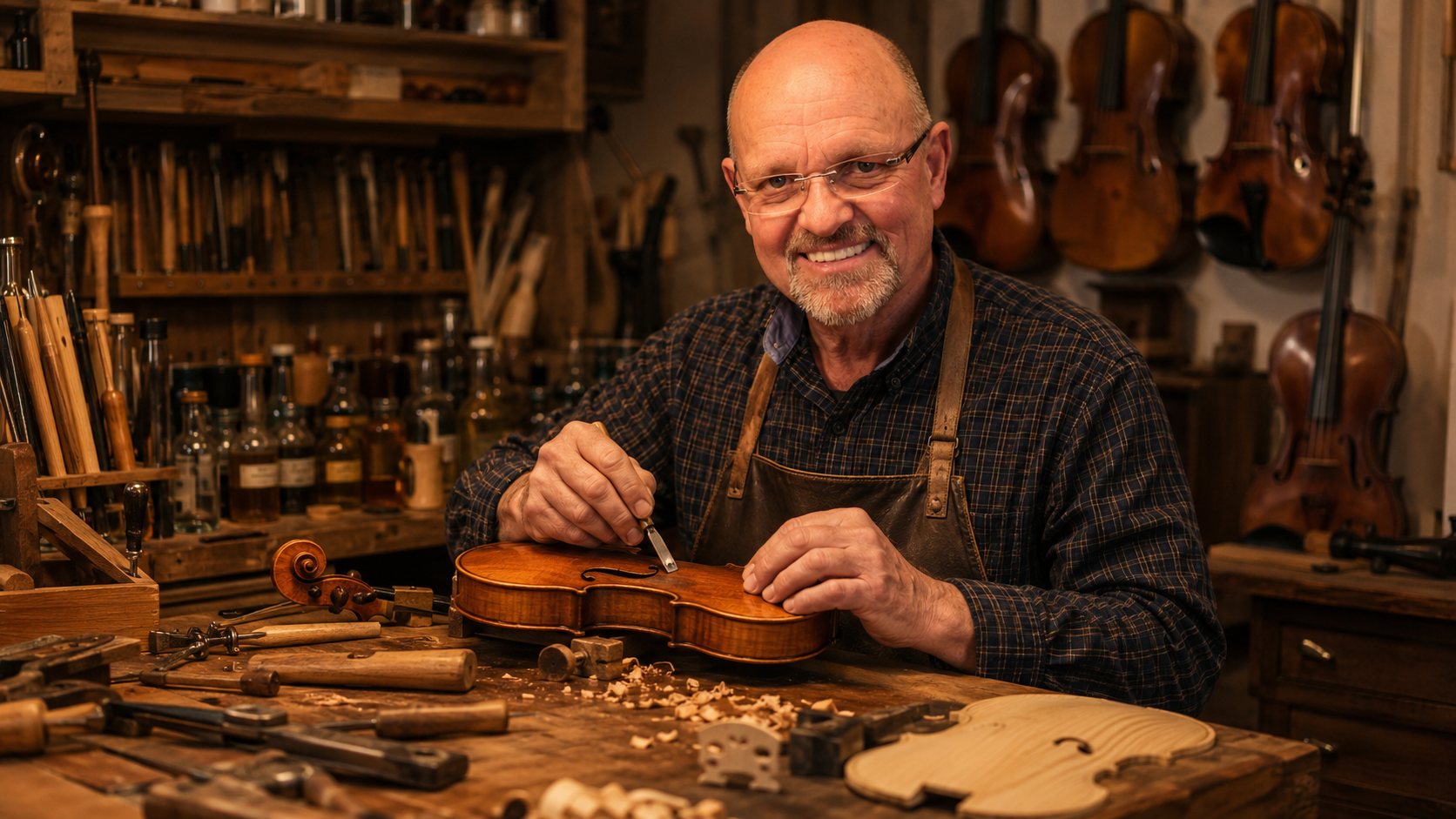
You reach out to the maker and tell him about your playing. Your style. Your repertoire. The tonal qualities you are chasing and the ones you are trying to leave behind. Hermann Janzen, who builds every violin by hand in his Mission, BC workshop, begins with that conversation. Not a catalog. Not a price list. A conversation.
From there, Hermann selects tonewoods with your instrument in mind. The spruce for the top, the maple for the back and sides, the proportions of the arching, the graduation of the plates. Each decision is made in the context of the player who will eventually hold this instrument. That is not a marketing phrase. That is the literal difference between a bespoke build and a production run.
When the instrument is finished, it is not handed over with a receipt. It is played. Adjusted. Voiced to the specific player. If something is not right, it does not leave the workshop. Hermann does not hand you a finished product and ask for a check. He matches the instrument to you, and that process continues until the match is real.
Why Graduation Is the Right Moment
Timing matters in a commission. A professional instrument built and matched to you at the beginning of your career grows with you in a way that a shop purchase rarely does. The relationship with the maker is part of the instrument's value. If something needs adjustment two years from now, you call Hermann. Not a call center. Hermann.
Graduation also represents a natural inflection point in a musician's identity. You are no longer a student borrowing the instrument's credibility. You are a professional asking the instrument to carry your voice. That psychological shift is real, and the instrument you play through it shapes how you hear yourself, how audiences hear you, and how quickly you close the gap between the musician you are and the one you intend to become.
There is also a practical argument. The players who commission early, before the name on the label becomes the purchase driver, are the ones who end up with instruments that are genuinely matched to them rather than instruments that impressed a room full of dealers. The Janzen workshop in Mission, BC is one of the rare access points to genuine professional-quality lutherie without the decade-long waiting list attached to the most sought-after contemporary makers internationally.
The Modern Maker Question
Here is the objection that lives in the back of every serious student's mind: can a contemporary Canadian maker actually deliver what an old Italian instrument delivers?
This is a fair question, and it deserves a direct answer.
The tonal principles that made the great Italian instruments legendary are not secrets locked in a Cremonese vault. They are principles of arching geometry, plate graduation, wood selection, and acoustic voicing that a serious maker studies, applies, and refines over a career. Hermann Janzen builds to those same principles. A player who purchased one of his instruments described it publicly as a Stradivarius copy with a powerful, brilliant sound. That is not marketing copy. That is what a musician said, unprompted, in a violin community forum.
The broader conversation in serious violin communities right now, on Reddit, YouTube, and in luthier forums, is actively wrestling with this question. Double-blind listening tests have repeatedly shown that modern masterwork instruments hold their own against old Italian instruments when the label is removed. The mythology of the old Italian instrument is real and worth respecting. But the assumption that a contemporary maker cannot approach that standard is not supported by evidence. It is supported by habit.
For a student entering professional life, the more relevant question is not old versus new. It is matched versus unmatched. A violin voiced specifically for how you play will outperform a violin with a famous label that was voiced for someone else three centuries ago.
What a Serious Instrument Actually Costs
The price of a Janzen commission sits in the professional-tier luthier market, comparable to mid-range contemporary maker pricing internationally. A documented sale of a Janzen instrument was made at approximately CAD $22,000, representing a first professional violin purchase by a serious player.
That number deserves context. A comparable instrument from a European boutique maker, purchased through a dealer, carries a similar price and adds a dealer margin on top. What the dealer cannot offer is the direct maker relationship, the custom voicing, and the ongoing access to the person who built the instrument. You are not paying more for a Janzen violin than you would for a comparable instrument elsewhere. You are paying the same price and receiving something the dealer model structurally cannot provide.
The real comparison is not $22,000 versus a $5,000 production instrument. The real comparison is $22,000 for a matched, bespoke instrument built by the person you can call, versus $22,000 for a transaction with a middleman and an instrument voiced for a showroom.
The Instrument Shapes the Player
This is the point that rarely gets said plainly enough in the conversation about instrument upgrades, so it is worth saying plainly here.
The instrument does not just reflect your playing. It shapes it. A violin that responds to everything you do teaches you to do more. A violin that meets you halfway teaches you to stop halfway. The players who reach the next level fastest are often the ones who stopped fighting their instrument and started playing one that responded to them.
For a graduating student standing at the beginning of a professional career, that is not a small detail. It is the whole game.
How the Janzen Process Begins
Hermann Janzen builds every violin by hand in Mission, BC. Each instrument is individually adjusted and matched to the player who will perform on it. The living voice of music is not a tagline for the workshop. It is the standard every instrument is built to meet.
If you are graduating this season, or approaching the moment when your current instrument is no longer keeping up with your playing, the conversation starts simply. You tell Hermann what you are looking for. He listens. That is how this begins.
Inquire about a commission at JanzenViolins.com. Tell Hermann about your playing and start the conversation.