Why Factory Violins Resist Your Most Expressive Playing
I want to tell you something a lot of violin teachers never say out loud, because it sounds like an excuse.
Sometimes the instrument is the problem.
Not your bow arm. Not your vibrato. Not the hours you have or haven't put in. The instrument itself. The way it was conceived, the wood that was chosen, the way it was assembled can place a ceiling on your expressiveness that no amount of practice will break through. And because nobody tells you this clearly, serious players spend years wondering what is wrong with them.
Nothing is wrong with you. But something may be deeply wrong with the instrument you are playing.
Here is what is actually happening, and why it matters.
What a Factory Violin Is Actually Built For
A factory violin is not built for you. It is built for a market.
The people who design production instruments are solving a very specific problem: how do we build a violin that sounds acceptable to the widest possible range of players, in the widest possible range of hands, at a price point that moves units? That is an engineering problem, not a musical one. And the solutions to that engineering problem are directly at odds with what an expressive player needs: standardized graduations, averaged arching profiles, machine-sanded plates, assembly-line finishing.
Standardized graduation means the top and back plates are carved to a thickness profile that works reasonably well for most players. Not for you. For most. The stiffness of the plates, which determines how the instrument responds to variations in bow pressure and speed, is set to a middle value. If your playing style demands a more sensitive response at the tip of the bow, or a deeper resonance on the G string, or a particular bloom in the upper register, the factory instrument has no mechanism to provide it. It was not built with your playing in mind. It was built to avoid being wrong for too many people.
That is a fundamentally different goal than building an instrument that is exactly right for one.
The Graduation Problem: Why Thickness Decides Everything
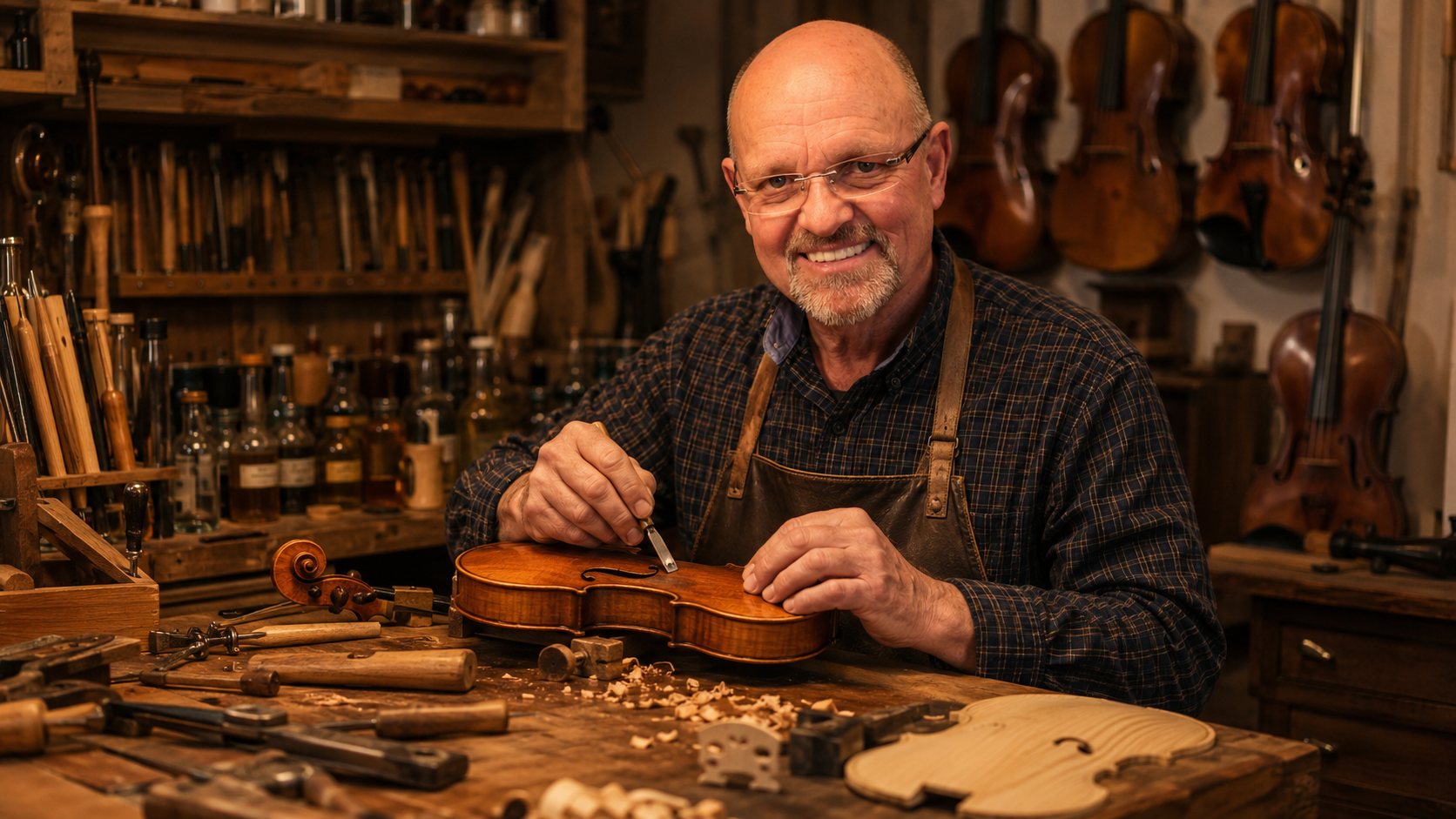
When a master luthier like Hermann Janzen carves a violin top, he is making hundreds of micro-decisions about thickness across the surface of the plate. A millimeter more stiffness near the bass bar area changes how the low strings speak. A slightly more flexible region under the treble foot of the bridge changes how the upper strings bloom on a long bow stroke. These decisions are not made from a chart. They are made by feel, by tap-tone testing, by the luthier's accumulated understanding of how wood behaves acoustically.
A factory instrument skips this entirely. The graduation is cut to a template. The template is based on averages derived from instruments that sold well, not instruments that were extraordinary. The result is a plate stiffness that is predictable, consistent, and acoustically mediocre.
When you try to play a nuanced pianissimo on a factory instrument, the plate does not respond with nuance. It responds with the same resistance it gives everyone. When you dig into a forte passage with real physical commitment, the instrument does not open up and meet you. It stays where it is. The ceiling is not your ceiling. It is the instrument's ceiling, installed at the factory.
Wood Selection and Why It Is Not a Luxury Detail
The second structural reason factory instruments resist expressive playing is wood selection. Or more precisely, the near-total absence of meaningful wood selection in production instruments.
Spruce for violin tops is not a uniform material. Two pieces of spruce cut from the same tree can have meaningfully different acoustic properties depending on where they came from in the trunk, how they were seasoned, the density of the growth rings, and the ratio of stiffness to weight along different axes. A master luthier spends years developing the ability to read these properties by eye, by feel, and by the sound the wood makes when tapped. He is selecting for a specific acoustic outcome. He is listening to the wood before it becomes an instrument.
A factory selects wood for visual consistency and cost. Tight, even grain looks premium in a catalog. It is not necessarily the grain that produces the most expressive tone. The wood that makes the most extraordinary violin is often the wood that looks slightly less perfect to an untrained eye but sings in a way that no machine-sorted plank ever will.
Hermann Janzen personally selects every piece of tonewood that goes into a Janzen violin. That selection is the first act of matching the instrument to the player. The character of the wood shapes the character of the sound before the first chip is carved.
Voicing: The Step That Factory Production Skips Entirely
Perhaps the single most important reason a factory violin resists your expressive playing is the absence of voicing.
Voicing is the process by which a luthier adjusts the finished instrument to optimize its acoustic response. It involves the precise fitting and positioning of the soundpost, the adjustment of the bass bar, the shaping of the bridge, and sometimes fine adjustments to the setup that can take hours of careful listening and testing. A skilled luthier voices an instrument the way a sound engineer mixes a recording: making small, intentional changes and listening to what they do to the whole.
Factory instruments receive a standardized setup. The soundpost is placed according to a formula. The bridge is cut to a template. The nut and saddle are set to tolerances that work for most players. This setup is designed to be acceptable. It is not designed to unlock the specific acoustic potential of that particular instrument in the hands of that particular player.
When Hermann Janzen finishes building a violin, the voicing process is not a final checklist item. It is a conversation between the instrument and the player who will own it. He adjusts, the player plays, he listens, he adjusts again. The instrument that leaves the workshop is not the instrument that came off the bench. It is the instrument that emerged from that specific exchange.
This is the step that factory production cannot replicate at scale. And it is the step that separates an instrument that performs from an instrument that truly sings.
The Matching Problem: Why the Right Violin Is Not the Best Violin on Average
Here is the insight that changes how serious players think about instrument acquisition.
The violin that is right for you is not the violin that is best on average. It is the violin that responds best to the specific way you play: your bow pressure, your contact point, your vibrato speed and width, your tendency to favor the upper or lower half of the bow, your physical build, your musical temperament.
A factory instrument cannot be matched to you because it was not built with the concept of a specific player in mind. A dealer instrument can be selected for you from existing inventory, but selection from inventory is still a constraint. You are finding the best available fit from a finite set of options, not building the right answer from the ground up.
A commissioned instrument from a single-maker workshop is a different category entirely. Hermann Janzen builds each violin knowing who it is for. The tonal decisions made during construction, the graduation choices, the wood selection, the arching profile, and the final voicing are all informed by an understanding of the player's needs. The result is an instrument that does not resist your expressiveness. It anticipates it.
One player in the violin community described a Janzen instrument as a Stradivarius copy with a powerful, brilliant sound. That description is not marketing language. It is what a player said, unprompted, after playing the instrument. It is the sound of a ceiling being removed.
What This Means If You Have Already Outgrown Your Instrument
If you have been playing seriously for years and you feel like your instrument is holding you back, I want you to consider the possibility that you are right.
Not as a consolation. As a diagnosis.
The frustration of fighting an instrument that does not respond to your most expressive intentions is a real and specific problem with a real and specific solution. The solution is not a better practice routine. It is an instrument that was built to meet you where you play.
The players who make the leap from a production instrument to a handcrafted one almost universally describe the same experience: they stop thinking about the instrument and start playing. The friction disappears. The ceiling lifts. The voice they have been trying to find through technique alone suddenly emerges through the wood.
That is not magic. It is craft. And it is available.
The Conversation That Starts Everything
Hermann Janzen builds every instrument by hand in his workshop in Mission, BC. Each violin is individually adjusted and matched to the player who will own it. The living voice of music is not a marketing phrase. It is what happens when a master luthier builds an instrument for a specific musician and refuses to stop until it sings.
If your current instrument has a ceiling you keep pressing against, the most useful thing you can do is begin a conversation.
Tell Hermann about your playing. Tell him what your current instrument does well and where it fails you. Tell him what you are reaching for that you cannot quite find. That conversation is how a Janzen violin begins.
And it is how the ceiling comes down.
Inquire about a commission at JanzenViolins.com. Tell Hermann what you are looking for. That is how this starts.