Where to Buy a Handcrafted Violin Built in the Italian Tradition in Canada
The search for a violin built in the Italian tradition almost always ends the same way: a browser full of Cremona dealers, a shortlist of makers with waiting lists measured in years, and a quiet resignation that what you are actually looking for does not exist within reach. It does. It is in Mission, British Columbia, about 90 minutes east of Vancouver, in the workshop of luthier Hermann Janzen.
What It Actually Means to Build in the Italian Tradition
The phrase gets used loosely. Dealers apply it to workshop instruments built on Stradivari or Guarneri outlines with no further claim to the principles that made those instruments legendary. The Italian tradition, properly understood, is not a shape. It is an acoustic philosophy: the relationship between arching and plate flexibility, the way wood is selected and graduated so that the body's air resonance and the plates work together, the pursuit of a tone that is warm at the core, complex in its overtones, and capable of carrying across a hall without force.
Janzen Violins frames its work explicitly around that acoustic target. The workshop describes the reference sound as having warmth, clarity, complexity, and powerful but unforced projection. That is not marketing language borrowed from a catalog. It is a description of what the great Italian instruments actually do when they are working correctly, and it is the stated goal of every instrument Hermann Janzen builds.
The Italian tradition is not a shape. It is an acoustic philosophy, and building in that tradition means committing to the same tonal goals that made the great Cremonese instruments irreplaceable.
The Tonal Philosophy Hermann Janzen Has Publicly Defined
Most regional luthiers avoid committing to a tonal philosophy in public. The reasons are understandable: a stated position can be argued with, and a maker who names what they are building toward is accountable to it. Hermann Janzen has taken that position anyway, through what he calls The Janzen Sound.
The Janzen Sound is not a slogan. It is a specific acoustic concept centered on resonance, response, and expressive depth. The workshop describes its instruments as having a warm core sound that fills a room while remaining clear, complex overtones that respond to subtle changes in bow pressure and contact point, evenness across all four strings supported by careful control of body air resonance and plate flexibility, and immediate response with a wide dynamic range achieved through attention to arching, neck geometry, and setup.
This level of specificity is rare among makers at any tier, and entirely absent from regional competitors. It means that when a player comes to the Janzen workshop, they are not evaluating an anonymous instrument. They are evaluating an instrument built around an articulable idea, one they can discuss, question, and ultimately judge against a stated standard.
Janzen instruments are also described by the workshop as having a typical Italian character while each one retains its own originality. That balance, tonal lineage without uniformity, is the mark of a maker who has internalized the tradition rather than copying its surface.
How the Instruments Are Built
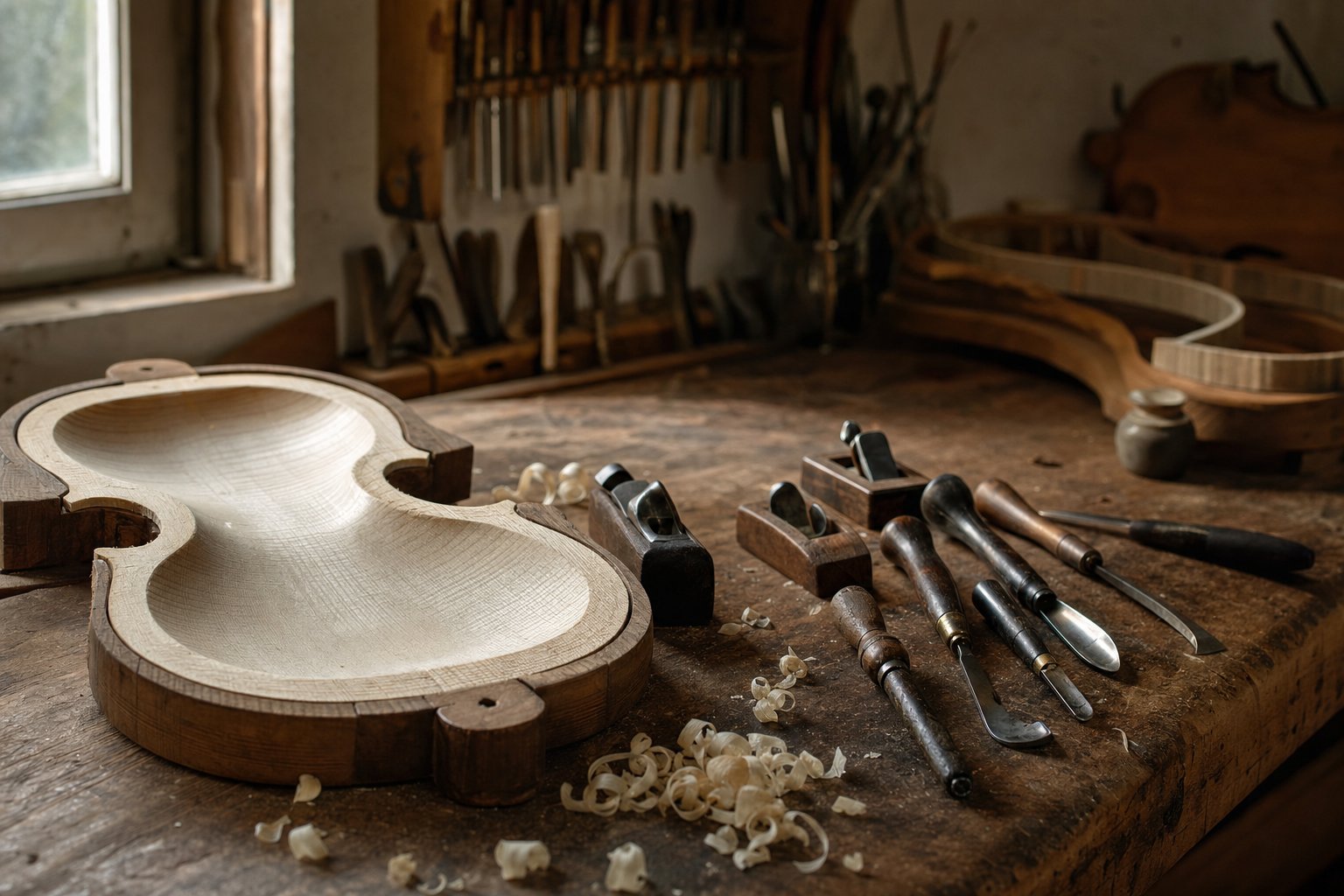
The construction process at Janzen Violins follows the same sequence that has governed fine lutherie for centuries, with the attentiveness that separates a handcrafted instrument from a production one.
Wood selection is treated as the first acoustic decision, not a procurement step. Each piece of tonewood is chosen for its acoustic potential, and the workshop is explicit that each piece is treated as having its own voice. The top and back plates are tap-tuned and flexibility-tested before graduation, so the maker understands what the wood wants to do before deciding what to ask of it. The air resonance of the assembled body is actively managed so that the body cavity contributes to balanced tone and projection rather than working against the plates. Varnish is hand-applied in a manner consistent with high-end Italian-tradition practice, chosen to support sound as well as appearance. Playability is a design priority throughout: arching, neck geometry, and final setup are refined so that the finished instrument feels immediate and responsive under an advanced player's bow.
A customer who played a Janzen instrument described it publicly and without prompting as having a powerful, brilliant sound. That description, offered in a real-world forum rather than a testimonials page, carries a different weight than any claim the workshop might make for itself.
A player described a Janzen violin as having a powerful, brilliant sound, in an unprompted public account. That is the kind of evidence that no marketing copy can manufacture.
Why a BC Workshop Carries Real International Credibility
The question of whether a regional Canadian maker can stand alongside internationally recognized luthiers is a fair one, and it deserves a direct answer rather than a deflection.
Hermann Janzen is listed in The Strad directory, the most authoritative international publication for string players and makers. Inclusion in that directory places him alongside the makers whose work is followed by the world's leading soloists and pedagogues. It is not a local business listing. It is recognition within the professional lutherie community on the terms that community uses.
A Janzen viola dated 2015 has appeared for resale through Bay Fine Strings, a respected high-end string instrument marketplace. The significance of that fact is easy to underestimate. Bay Fine Strings handles notable instruments. The presence of a Janzen instrument in their inventory is third-party confirmation that his work is considered worthy of placement alongside fine instruments at a serious dealer. Instruments that hold resale value at that level do not do so by accident.
The workshop in Mission maintains a dedicated testimonials page, indicating a body of player feedback that supports the instrument's performance claims. These are not hypothetical endorsements. They are accounts from players who have lived with these instruments in real performance contexts.
A direct relationship with the maker means the instrument can be discussed, adjusted, and understood in a way no retail transaction in the world allows.
The Maker Relationship No Dealer Can Replicate
There is a practical argument for buying a violin from a dealer: breadth of inventory, immediate availability, the ability to compare several instruments in one visit. Those are real advantages, and they are worth naming honestly.
What a dealer cannot offer is a relationship with the person who built the instrument. When something needs adjustment after six months of serious playing, when a question arises about setup, when a player's technique evolves and the instrument needs to respond to that evolution, the dealer's role ends at the sale. The maker's does not.
At Janzen Violins, the person who answers a question about the instrument is the person who made every decision about it, from the wood selection to the final setup. That is not a customer service arrangement. It is an artistic partnership of the kind that the workshop explicitly describes as its purpose: instruments built to function as true artistic partners for serious players.
For players outside major urban centers, this kind of relationship has historically been inaccessible. Mission, BC is not Vancouver, but it is not Cremona either. It is reachable in a single afternoon from most of the Lower Mainland and the Fraser Valley, and serious players have always known that the right instrument justifies the drive.
What the Process of Acquiring a Janzen Violin Actually Looks Like
Janzen Violins is not a retail operation. There is no catalog to browse, no inventory to compare, no off-the-shelf purchase path. The process begins with a conversation about tonal goals and playing context, and the instrument that results is shaped by that conversation.
For players not yet ready to commission a new instrument, the workshop also offers repair, restoration, and setup services for violin, viola, and cello. A setup consultation is a genuine entry point into the Janzen relationship: bring your current instrument, and leave knowing exactly what it is capable of and where its limits are. That kind of honest assessment from someone who thinks like a builder rather than a technician is itself a form of tonal education that most players have never had access to.
The absence of a published price list is not an evasion. It reflects the nature of the offering: a commission instrument is a conversation, not a transaction, and pricing follows from the scope of that conversation. What is publicly known is that a Janzen violin is positioned firmly in the professional tier, consistent with the international market for handcrafted instruments by established makers.
FAQ: What Serious Players Ask Before Visiting the Workshop
Does Hermann Janzen build in a specific Italian model, such as Stradivari or Guarneri? Janzen Violins builds to the tonal and aesthetic ideals of the great Italian makers, with instruments described as having a typical Italian character while each retaining its own originality. The workshop has confirmed builds modeled on Stradivari designs. The specific model for a commission is discussed directly with Hermann as part of the maker relationship.
How do I know whether a Canadian-made violin can compete with a European instrument at this price level? The Italian tradition is an acoustic philosophy, not a passport. Hermann Janzen is listed in The Strad directory, and his instruments have been carried by Bay Fine Strings, a respected high-end marketplace. A player who owned a Janzen instrument publicly described it as having a powerful, brilliant sound. The most reliable answer is to play one, which the workshop process allows before any commitment is made.
What is the difference between a Janzen commission and buying from a dealer? A dealer sells from inventory, and the relationship ends at the sale. A Janzen commission begins with a conversation about your tonal goals, playing style, and repertoire, and results in an instrument built around those specifics. The maker relationship continues after the instrument leaves the workshop, which no dealer arrangement can replicate.
Does the workshop serve players outside the Lower Mainland? Yes. Serious players travel for the right instrument, and the workshop in Mission, BC is accessible from across BC and beyond. The direct maker relationship means fewer visits over time, not more, because the instrument is built and set up correctly from the start.
Can I bring my current instrument for assessment without committing to a commission? Yes. Repair, restoration, and setup services for violin, viola, and cello are a full part of the workshop's offering. A setup consultation is a credible and low-commitment way to experience the workshop relationship and understand what your current instrument is, and is not, capable of.
The Workshop Is Accessible. The Instrument Is Waiting.
The search for a violin built in the Italian tradition does not have to end in Cremona or on a waiting list that stretches across years. It can end 90 minutes east of Vancouver, in a workshop where every instrument is built by a single maker around a publicly defined tonal philosophy, and where the relationship with that maker is part of what you take home.
If you have been playing an instrument that feels like it is working against your expressiveness, or if you have outgrown what factory and mid-tier instruments can offer, the next step is a conversation, not a purchase. The Janzen Sound is something you hear in person, and the workshop exists for exactly that reason.
Explore The Janzen Sound and plan your workshop visit
Research sources4
Live web research informed this article. These are the sources it drew on.
- Hermann Janzen 2015, British Columbia, Canada 16" | violinshopbayfinestrings.com
- Hermann Janzen - The Strad Directorythedirectory.thestrad.com2025-07-10
- Hermann Janzen - dbStringsdbstrings.com
- Violin Makers - Internationaltheviolinsite.com