When Your Violin Stops Growing With You
There is a moment every serious player knows, even if they have never put words to it. You are mid-phrase, somewhere in a passage you have played a hundred times, and the sound that comes back to you is not the sound you heard in your head. The instrument is not wrong exactly. It is just not enough. It plateaus where you want to soar. It goes thin where you need warmth. It disappears in a hall when the music asks you to fill it.
That moment is not a crisis of technique. It is a signal. Your playing has outgrown the instrument underneath it, and no amount of practice or adjustment is going to close that gap.
Graduating from a student or mid-tier instrument to your first truly handcrafted violin is one of the most significant decisions a serious musician will make. It is also one of the least understood. This article is for the player who is ready to take that step and wants to understand what they are actually looking for before they walk into a workshop or a showroom.
What a Student Instrument Actually Does
A good student violin does exactly what it is designed to do. It is built to survive the learning years: robust construction, predictable response, a tone that is forgiving of inconsistent bow technique. The best of them are genuinely fine instruments for their purpose. The problem is not quality. The problem is intention.
Factory and workshop instruments are built to a specification, not to a player. The tonewoods are selected for consistency and availability. The arching and graduation follow templates refined for broad playability. The setup is optimized for the middle of the range, not the edges. These are not failures. They are engineering choices that make sense for instruments that will be played by thousands of different students across their lifetimes.
But when your playing reaches the edges of what those choices allow, you will feel it. You will push for more projection and find the ceiling. You will reach for a color in your tone and find the palette is limited. You will play a quiet passage with intention and find the instrument does not respond to the subtlety you are offering it.
This is the plateau every advancing player eventually hits. And crossing it requires a fundamentally different kind of instrument.
What Changes When You Commission a Handcrafted Violin
The word handcrafted gets used loosely in the instrument market. It is worth being precise about what it means at the level of a serious commission.
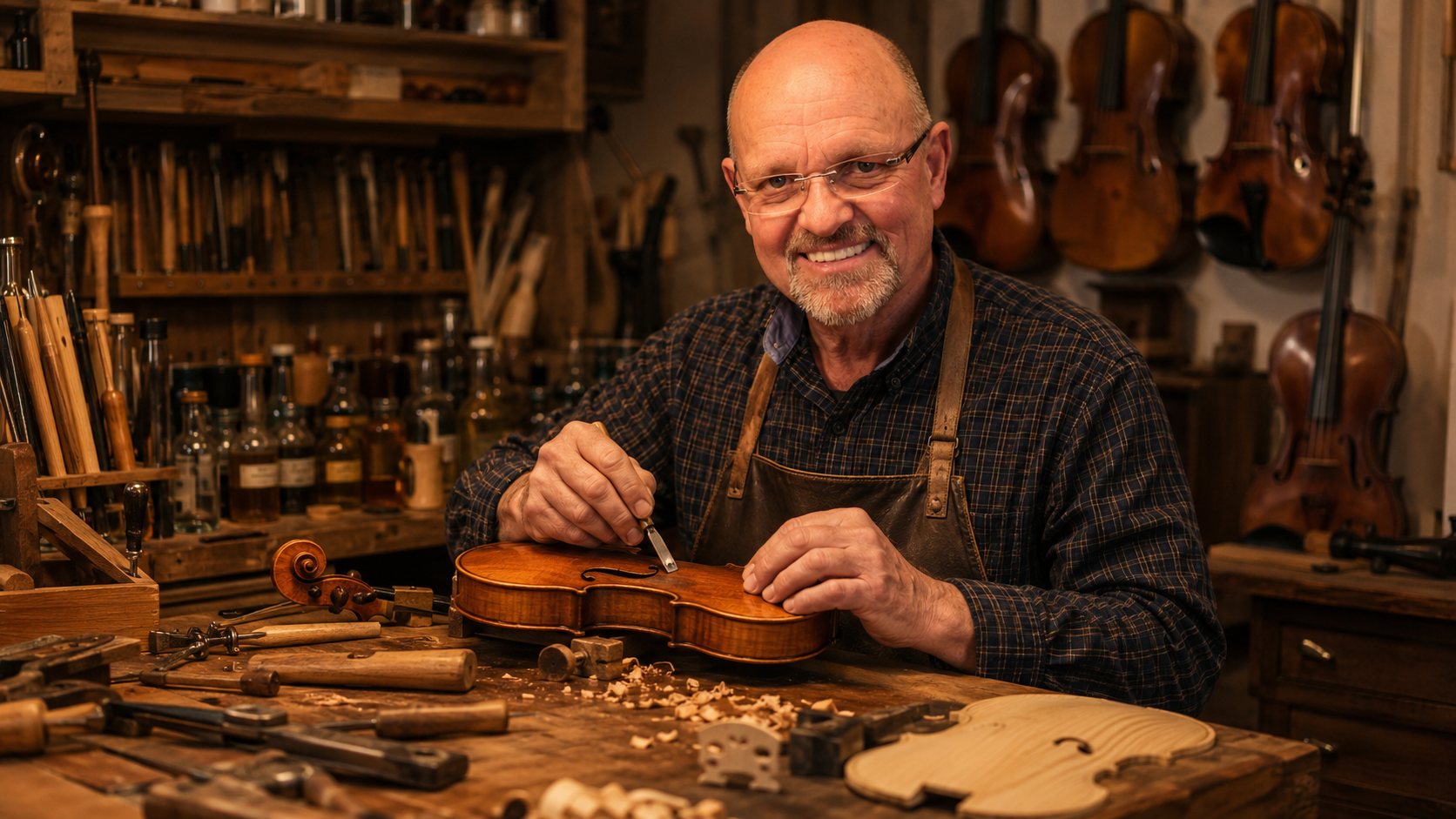
When Hermann Janzen builds a violin in his Mission, BC workshop, every decision in the process is made by a single pair of hands with a single tonal intention. The spruce for the top is selected for tap tone and stiffness, not just appearance. The maple for the back and sides is chosen for how it will contribute to the instrument's voice, not for how it photographs in a catalog. The arching is shaped to his interpretation of the great Italian models. The graduation is carved by feel as much as by measurement. The bass bar and sound post are fitted to that specific instrument, not to a standard specification.
None of this is theoretical. A player in the professional violin community has described a Janzen instrument as a Stradivarius copy with a powerful, brilliant sound. That description did not come from a press release. It came from a musician who played the instrument and reported what they heard.
The difference between a factory instrument and a handcrafted one is not a matter of price point or prestige. It is a matter of how many intentional decisions went into the instrument before it ever touched a bow.
The Matching Process: Why It Changes Everything
Here is the part of the handcrafted violin conversation that most players have never considered, because most dealers have no incentive to tell them about it.
A great instrument is not universally great. It is great for a specific player with a specific bow arm, a specific style, and a specific musical voice. An instrument that sings under one player can feel stiff and unresponsive under another. The tonal characteristics that make a violin perfect for a chamber musician may make it the wrong choice for an orchestral section player.
This is why the matching process matters as much as the building process.
Hermann's approach is not to build an instrument and then find a buyer for it. It is to understand the player first: how they bow, what repertoire they play, what tonal qualities they are chasing, what their current instrument is failing to give them. The finished violin is then adjusted and voiced with that player in mind. Setup details that seem minor on paper, such as string height, sound post position, and string choice, can shift the entire character of an instrument's response. In the hands of a maker who built the violin, those adjustments are made with a depth of understanding no repair shop technician can replicate.
This is the maker-to-player relationship. It is not a sales process. It is a craft process, and it produces instruments that feel built for you because, in a meaningful sense, they are.
The Objection Every Serious Player Has
Can a contemporary Canadian maker really compete with a European instrument at this price?
This is the question serious players ask, and it deserves a serious answer.
The short answer is yes, and the evidence is in the playing. But the longer answer is more interesting.
The tonal ideals of the great Italian makers, Stradivari, Guarneri, Amati, live in the method, not the geography. The principles of arching, graduation, wood selection, and varnish that produced those instruments are documented, studied, and practiced by the finest contemporary makers around the world. A luthier in Mission, BC who has devoted his craft to those principles is working from the same tradition as a luthier in Cremona.
What the contemporary maker offers that the antique instrument cannot is something equally important: a direct relationship with the person who built it. When something needs adjustment, you call Hermann. Not a dealer. Not a shop manager. The person who carved the top.
A seven-figure Stradivarius comes with provenance and legend. A Janzen violin comes with the maker himself. For a working musician who needs an instrument that responds to their growth over decades, that relationship has a practical value that no amount of historical prestige can replicate.
What to Expect From the Commission Process
If you have only ever bought instruments from dealers or shops, the commission process will feel different from the first conversation.
It begins with a discussion, not a transaction. Hermann wants to understand your playing before he puts wood to plane. What are you playing now? What does it do well? What does it fail to give you? What kind of music do you perform? What do you mean when you say you want more warmth, more projection, more singing tone?
These are not sales qualification questions. They are the same questions a tailor asks before cutting cloth. The answers shape decisions that will be made months later, in the quiet of the workshop, when no one is watching.
The timeline for a commission is measured in months, not weeks. This is not a limitation. It is a feature. The instrument you receive at the end of that process was not rushed. Every hour of carving, fitting, and finishing was given to your violin specifically. The wait is part of what you are paying for.
And yes, you play the instrument before any final commitment. If it does not sing to you, it does not leave the workshop with you.
How to Know You Are Ready
Players often ask whether they are at the right level to justify a handcrafted instrument. The question itself reveals a misunderstanding of what the instrument does.
A serious instrument does not reward players who have already arrived. It accelerates players who are on their way. The tonal complexity and responsiveness of a great violin gives an advancing player feedback that a factory instrument cannot: it responds to subtlety, rewards bow technique, and reveals the expressive range the player is developing. It is a teacher as much as a tool.
If you are fighting your instrument more than you are playing it, you are ready. If the sound in your head is consistently larger than the sound coming back to you, you are ready. If you have outgrown three teachers and two orchestras but you are still playing the same violin you bought at sixteen, you are ready.
The Living Voice of Music
Hermann Janzen did not choose lutherie as a career path. He came back to it by something closer to calling. That origin story matters not because it makes for a good biography but because it shapes every instrument that comes out of the workshop.
An instrument built by someone who had to build it carries something different than an instrument built by someone who had to fill an order. The difference is not mystical. It is practical. It shows up in the hours spent on a single graduation curve, in the willingness to reject a piece of wood that is technically acceptable but tonally wrong, in the patience to voice an instrument over weeks rather than days.
The phrase that anchors everything at Janzen Violins is the living voice of music. It is not marketing language. It is a description of what a great instrument actually does: it speaks. It has a voice that is distinct from the player's voice but in conversation with it. The best performances happen when those two voices are matched so well that the distinction between them disappears.
That is what a commission from Hermann Janzen is designed to produce.
Begin the Conversation
If you have read this far, your current instrument is probably already telling you something. The question is whether you are ready to listen.
The first step is a conversation, not a commitment. Tell Hermann about your playing. Tell him what your instrument gives you and what it withholds. Tell him what you are chasing.
That is how it starts.
Inquire about a commission at Janzen Violins and begin the conversation today. The workshop is in Mission, BC. The maker answers the phone himself.
P.S. The 2026 Contemporary Violin and Bow Makers Exhibition in New York City runs October 22 to 24. Janzen Violins will be among the contemporary makers represented. If you have been waiting for a signal that the name belongs in that company, that is it.