The Hidden Cost of Fighting Your Violin
You can hear it before you can explain it. The note you reach for that simply isn't there. The projection that disappears the moment an ensemble fills the room. The sense that no matter how much you give, the instrument gives back less. This is what it costs to perform on a violin that fights you. And most serious players are paying that price without realizing it has a name.
The Plateau That Isn't About Your Playing
Every advanced student and working professional eventually hits a wall. The instinct is to blame technique: bow arm, intonation, practice hours. Teachers suggest refinements. You work harder. The wall stays.
What almost no one says out loud is this: sometimes the ceiling is the instrument, not the player.
A violin built to a production standard is engineered to be acceptable across a wide range of players and a wide range of price points. That breadth is the product. The tonal complexity that a serious performer needs, the layered harmonics, the dynamic range from whisper to roar, the responsiveness to subtle changes in bow pressure, these are not factory priorities. They are the priorities of a maker who builds one instrument at a time, for one player at a time.
The ceiling you keep hitting might not be your technique. It might be the instrument you're asking to carry you past it.
The players who break through that plateau are rarely the ones who practiced harder. They are the ones who finally stopped fighting their instrument and started playing one that responded to everything they had.
What "Fighting the Instrument" Actually Means
The phrase turns up constantly in professional violin communities, on forums, in lesson rooms, in the wings before a performance. "I feel like I'm fighting it." Players use it instinctively, but it describes something precise.
A violin that fights you requires you to compensate. You adjust your bow speed to coax a tone the instrument should give freely. You press harder into the string to find a projection the instrument should produce naturally. You work around the instrument's limitations instead of through your own musical intention. Over months and years, those compensations become habits. The habits shape your technique. The technique you build on a limited instrument is a technique built around limitation.
This is the hidden cost that never appears on a price comparison. It isn't the number on the invoice. It is the playing you never quite reach because the instrument you practiced on couldn't show you what was possible.
The conversation happening right now in serious violin circles, whether a modern violin maker can genuinely match the tonal legacy of old Italian masters, matters here. The answer, increasingly, is yes. And the players making that discovery are not doing it in auction houses or at European trade fairs. Some of them are driving to Mission, BC.
What the Great Makers Understood That Factories Don't
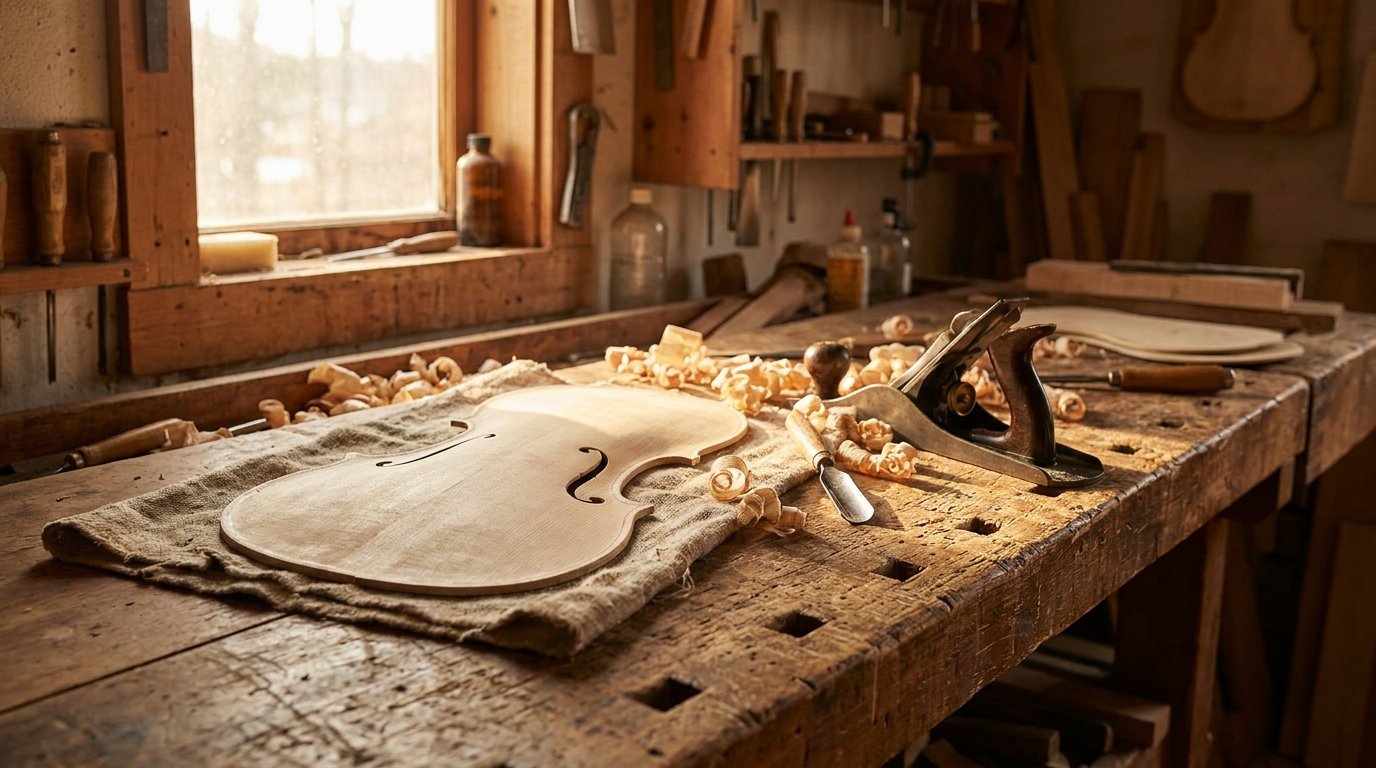
The reason a Stradivarius commands seven figures is not purely historical romance. It is tonal architecture. The arching of the top plate, the graduation of the wood, the precise fit of the bass bar and soundpost, the selection of tonewood with specific acoustic properties. These decisions, made by a single craftsman with a single instrument in mind, create a voice that a production process cannot replicate.
A contemporary violin maker working in the tradition of the great Italian makers is not copying a label. They are working from the same principles: slow selection of materials, hand-carving to acoustic response rather than template, voicing decisions made for the specific instrument rather than a production run. The result, when the maker has genuine mastery, is an instrument that behaves like a living thing under the bow.
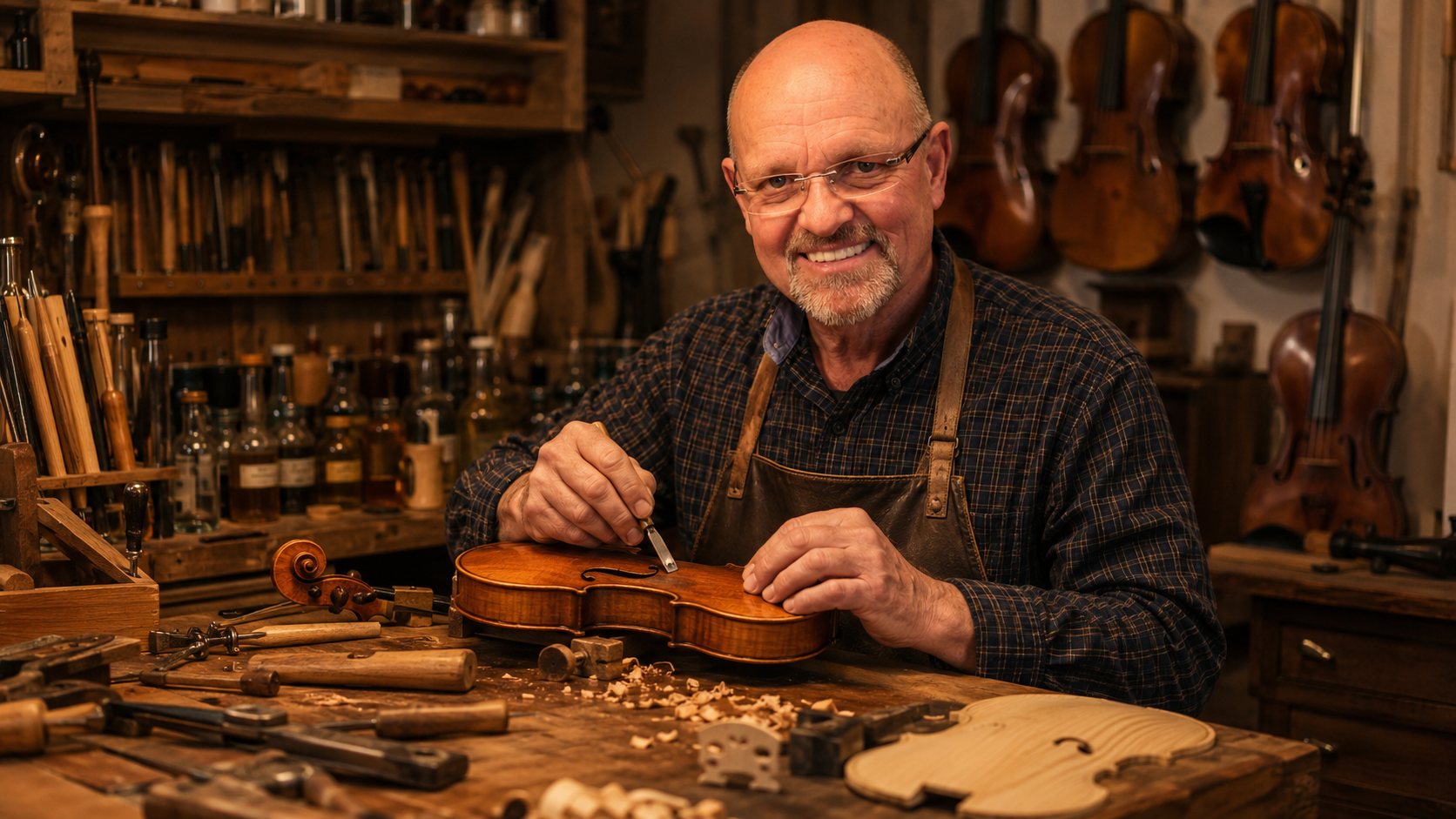
Hermann Janzen builds every violin by hand in his workshop in Mission, BC, modeled on the tonal and aesthetic ideals of Stradivari and Guarneri. Not the mythology. The method. A player who found one of his instruments through the professional violin community described it unprompted as a Stradivarius copy with a "powerful, brilliant sound." That is not marketing language. That is what the instrument did to someone who played it.
This is what separates a boutique luthier from a retail shop selling workshop violins at a premium price. The Fraser Valley is not Cremona. But the principles that made Cremona legendary are not geographic. They travel with the maker who has internalized them.
The Matching Question Nobody at a Dealer Will Ask You
Walk into any violin shop in Greater Vancouver and the process is the same. You try instruments. The shop tells you which ones are in your price range. You form an opinion under showroom acoustics, under time pressure, with an instrument that was set up to impress a wide range of players rather than to fit you specifically.
The question no dealer asks is: how do you play?
Not what level you are. Not what repertoire you're working on. How do you play. What is your bow arm like. What kind of tone do you reach for instinctively. What does your instrument do well right now, and what does it refuse to give you. What does your playing need that it isn't getting.
These are the questions that determine whether an instrument is right for you. Not its provenance, not its label, not its showroom impression. Hermann Janzen's process begins with these questions. The instrument-matching conversation is not a sales consultation. It is a maker trying to understand a musician well enough to put the right voice in their hands.
A violin that fits you plays differently than a violin that fits everyone. That difference is not subtle. It changes what you believe you are capable of.
This is the differentiator that no competitor in the region has chosen to lead with. Every shop in Greater Vancouver sells inventory. Janzen Violins matches instruments to players. The distinction sounds philosophical until you play the result.
Why Skepticism About Modern Makers Is Understandable and Outdated
The hesitation is reasonable. The market has trained serious players to associate genuine lutherie with Italy, Germany, and France. With names that appear in auction catalogs and music history textbooks. A contemporary Canadian maker working in a Fraser Valley workshop does not fit the picture that decades of marketing have painted.
But the picture is changing. The live debate in professional violin communities right now, about modern violin maker versus Stradivarius, the double-blind tests, the growing recognition of contemporary makers in international exhibitions, is eroding a mythology that was always partly commercial fiction.
The 2026 Contemporary Violin and Bow Makers Exhibition in New York City, running October 22 through 24, will place the world's top living luthiers beside each other for serious evaluation. The question is not whether handcrafted violin Canada can compete with old Italian instruments. That question is already being answered in workshops like Hermann Janzen's, one instrument at a time, one player at a time.
The players who discover serious contemporary makers early are not taking a risk. They are making the same discovery that every generation of musicians eventually makes: that the instrument that changes your playing is rarely the one you expected, and almost never the one a dealer was most eager to sell you.
The Real Investment Calculation
A handcrafted violin commission from a boutique luthier is a significant financial decision. That is simply true, and no serious conversation about it should pretend otherwise.
But the calculation most players run is incomplete. They compare the commission price to the price of a production instrument at a similar number. They ask whether the handcrafted violin is worth the difference in dollars. The more useful question is what the production instrument costs in the years of playing on it. The compensations built into technique, the expressive ceiling that never lifts, the performance that stays just below what it could be.
The players who have been through this describe it consistently. They stopped thinking about the instrument and started playing. The technical problems that seemed like their own limitations turned out to be the instrument's. The voice they had been reaching for was there, finally, because the instrument could carry it.
Hermann Janzen builds every instrument with this outcome as the only acceptable standard. You play it before you decide anything. If it doesn't sing to you, it doesn't leave the workshop with you. The conversation begins with your playing, not with a price list.
Stop Fighting. Start Playing.
The violin you perform on is not a neutral tool. It shapes what you can hear in yourself, what you can ask of your technique, what an audience receives from your playing. A factory instrument engineered for broad acceptability will give you broad acceptability. An instrument built by a single maker, adjusted to your specific playing, and matched to your musical voice will give you something else entirely.
If you have been feeling the friction, the sense that you are working harder than the music should require, that your instrument is a ceiling rather than a door, that feeling is data. It is telling you something worth listening to.
Hermann Janzen's workshop is in Mission, BC, ninety minutes from Vancouver. The conversation starts with your playing. Tell Hermann what you are looking for, what your current instrument gives you and what it doesn't, and what you need a violin to do for you. That is how this begins.
Inquire about a commission at JanzenViolins.com. The living voice of music is waiting.