How Wood Selection Decides the Voice of Your Violin
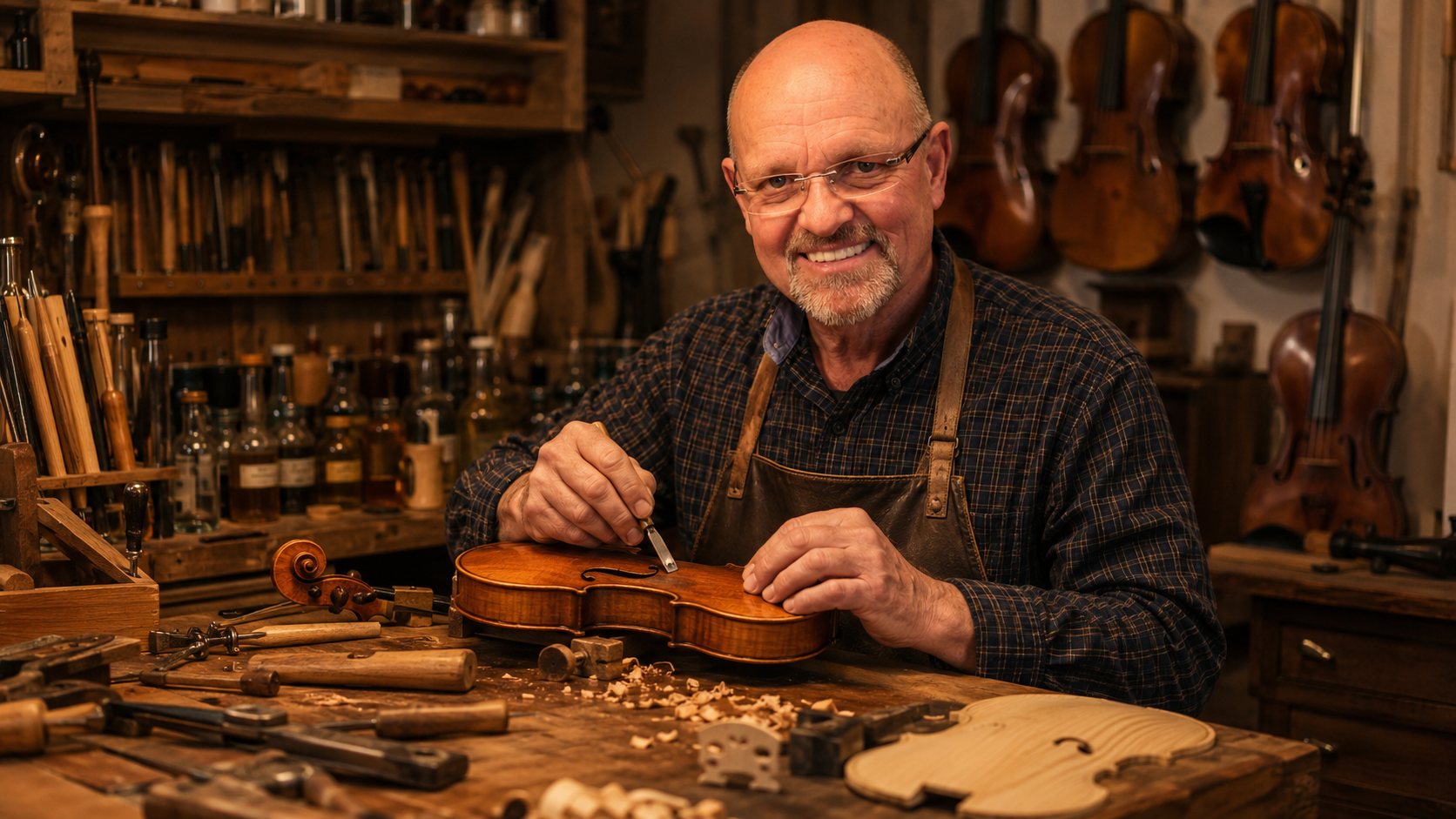
I want to tell you something that most violin dealers will never say out loud.
The difference between a violin that sings and a violin that merely plays is not decided at the bench. It is not decided during varnishing, or fitting, or the final setup adjustment. It is decided on a quiet morning when a luthier picks up a piece of wood, taps it with a knuckle, tilts it toward the light, and either sets it aside or sets it on the shelf that matters.
Tone begins in the wood. Everything that comes after is refinement. But you cannot refine what was never there.
This is the part of violin making that almost no one talks about, because it is the hardest part to explain and the easiest part to skip if your goal is volume rather than voice. At Janzen Violins in Mission, BC, Hermann Janzen does not skip it. He has never skipped it. And understanding why changes how you think about what a handcrafted instrument actually is.
What the Great Italian Makers Knew That We Forgot
Antonio Stradivari did not build his instruments from whatever spruce and maple happened to be available. He was, by most accounts, obsessive about his tonewoods. He selected from the alpine forests of the Val di Fiemme in northern Italy, where the combination of altitude, temperature, and slow growth produces wood with a density, stiffness, and resonance ratio that luthiers still chase today.
The reason those instruments still command seven-figure prices is not purely age or mythology. It is partly the wood. Slow-grown alpine spruce with tight, even grain produces a top plate that vibrates in a way that broader-grained, faster-grown wood simply cannot replicate. The cells are smaller, the structure more uniform, and the acoustic result is a kind of clarity and projection that players describe in emotional rather than technical terms: singing, alive, responsive, present.
Modern makers who build to those same ideals do not just copy the shape. They source the wood with the same intention. This is where a commission from a single-maker workshop like Janzen Violins diverges from anything a production facility can offer. When you buy a factory instrument, you are buying a design. When you commission a Janzen violin, you are buying a decision made on a morning you were not there for, when Hermann stood in his workshop and chose the wood that would become your instrument.
The Two Woods That Make a Violin
Every violin is built from two primary tonewoods: the top, almost always European or Sitka spruce, and the back and sides, almost always maple. These are not interchangeable. Each does a different acoustic job, and the relationship between them determines the character of the instrument.
The spruce top is the voice box. It is the plate that moves most under the vibration of the strings, transmitting energy through the bridge and into the air around it. A good spruce top is stiff across the grain and flexible along it, a combination that allows it to respond quickly to the bow and project the sound outward rather than absorbing it. The grain lines visible on the face of a fine violin top tell part of the story: tight, even lines running parallel from bass bar to treble side indicate slow growth and consistent density. Wide, irregular grain indicates the opposite.
But grain lines are only the beginning. Hermann evaluates a spruce top by tap tone, the resonant frequency the wood produces when you knock it with a knuckle and listen. A plate with the right acoustic properties will ring with a clear, bell-like decay. A plate with less potential will sound dull, or short, or uneven across its surface. This is not mysticism. It is applied acoustics, and it is a skill that takes years of quiet attention to develop.
The maple back and sides do something different. Maple is denser and harder than spruce, and its job is to reflect and focus the sound rather than radiate it. The figure in maple, that rippled, three-dimensional shimmer called flame or curl, is not purely decorative. Heavily figured maple has a slightly different cellular structure than plain maple, and many luthiers, including Hermann, find that it contributes to the brightness and complexity of the upper register. The relationship between a reflective maple back and a radiating spruce top is what creates the tonal balance a great violin needs: warmth without muddiness, brightness without shrillness, power without hardness.
What Hermann Is Actually Looking For
When Hermann Janzen evaluates tonewoods for a commission, he is not running down a checklist. He is building a mental model of the instrument before it exists.
He is thinking about the player. A violinist with a naturally warm, full tone and a heavy bow arm needs a top that can handle that energy and project it without closing up. A player with a lighter touch and a faster bow needs a top that is responsive at low pressure, one that speaks immediately rather than requiring work to open up. The wood has to match the musician, not just the blueprint.
He is thinking about the model. Hermann builds to the ideals of the great Italian makers, and different models such as Stradivari versus Guarneri del Gesu have different arching profiles that interact with the tonewood differently. A higher arch tolerates a slightly less stiff top. A flatter Stradivari arch demands more from the spruce because there is less mechanical advantage in the structure itself. The wood choice and the model are in conversation before the first template is laid down.
He is thinking about the future. A violin that sounds remarkable at delivery but does not open up and deepen over years of playing is a missed opportunity. The best tonewoods are not just acoustically strong today but are acoustically alive in a way that responds to playing, to vibration, to the gradual microscopic changes that happen in wood under decades of use. Hermann is making a choice that will still be paying dividends twenty years from now.
Why Aging and Drying Matter as Much as Species
Green wood does not make great violins. This sounds obvious, but the implications are more significant than most players realize.
Freshly cut spruce contains moisture in its cell walls. As that moisture leaves, the wood shrinks, shifts, and stabilizes. A violin top built from insufficiently dried wood will move after it is assembled, opening seams, affecting neck angle, and, most critically, changing its acoustic properties in ways that are difficult to predict and impossible to fully control. The varnish cracks. The tap tones shift. The instrument the player receives is not the instrument it will be in five years.
Proper air-drying of tonewoods takes years, not months. The best luthiers maintain a stock of wood that has been drying for a decade or more, because they know that stability is not just a structural virtue. It is an acoustic one. Fully dried, fully stable spruce vibrates more freely than wood that is still releasing moisture. The cells are no longer fighting the movement. The wood is ready.
Hermann maintains a stock of aged tonewoods for exactly this reason. When he selects the spruce for your instrument, it is not wood that arrived last season. It is wood that has been waiting, drying, stabilizing, becoming what it needs to be. That patience is built into the instrument before a single plane touches the surface.
The Moment of Selection: What It Looks Like in the Workshop
If you were to stand in Hermann's workshop on a wood selection day, here is what you would see.
Planks of quarter-sawn spruce, some bookmatched, some single-piece, leaning against the wall or stacked on shelves. Pieces of flamed maple in various widths. Hermann moving slowly through them, lifting a piece, holding it toward the window light to read the figure, setting it flat on the bench and running a thumb along the grain. Then the tap. A knuckle to the surface, an ear tilted down, a pause. Sometimes a second tap. Sometimes the piece goes back. Sometimes it stays.
There is no drama in it. It looks like a quiet man making a quiet decision. But that decision, made before the first pencil line, before the first template, before any of the work that takes months to complete, is the decision that determines whether the finished instrument will merely be a violin or will be a voice.
This is what you cannot buy at a dealer. The dealer can show you the finished instrument. They cannot show you this morning.
What This Means for the Player Commissioning an Instrument
If you are a serious player considering a commission, understanding the wood selection process changes what questions you should be asking.
Do not ask only about the model or the varnish or the delivery timeline. Ask about the wood. Ask where it came from. Ask how long it has been drying. Ask how Hermann thinks about matching the tonewood to your playing style. A luthier who can answer those questions in detail is a luthier who is thinking about your instrument as a singular object, not a production unit.
At Janzen Violins, that conversation is the beginning of the commission, not a footnote to it. Hermann will ask you about your playing before he ever picks up a piece of wood for your instrument. He will want to know your repertoire, your bow arm, the halls you play in, the tonal character you are chasing. Then he will go to his stock and make a choice that is specific to you.
A player who commissioned a Janzen instrument described it as a Stradivarius copy with a powerful, brilliant sound. That description did not begin at the bench. It began on a morning like the one described here, with a luthier and a plank and a knuckle tap, and a decision that no factory and no dealer can replicate.
The Living Voice Starts Here
The phrase 'the living voice of music' is not marketing language at Janzen Violins. It is a description of what Hermann is trying to build into every instrument from the first moment of its existence.
A violin is not a passive object. It is a resonating system, and like any resonating system, it is only as good as the materials from which it is built. The great Italian makers understood this. The contemporary makers who build to those same ideals understand it. And the players who commission those instruments, who take the time to understand the process behind what they are holding, understand why the instrument feels different under the bow.
It starts with the wood. It starts before the first cut. It starts with a luthier who knows what he is listening for and has the patience to wait until he hears it.
If you are ready to begin that conversation, tell Hermann about your playing. That is how this starts.
Inquire about a commission at Janzen Violins. Janzenvioins.com