How a Luthier Matches a Violin to Your Voice
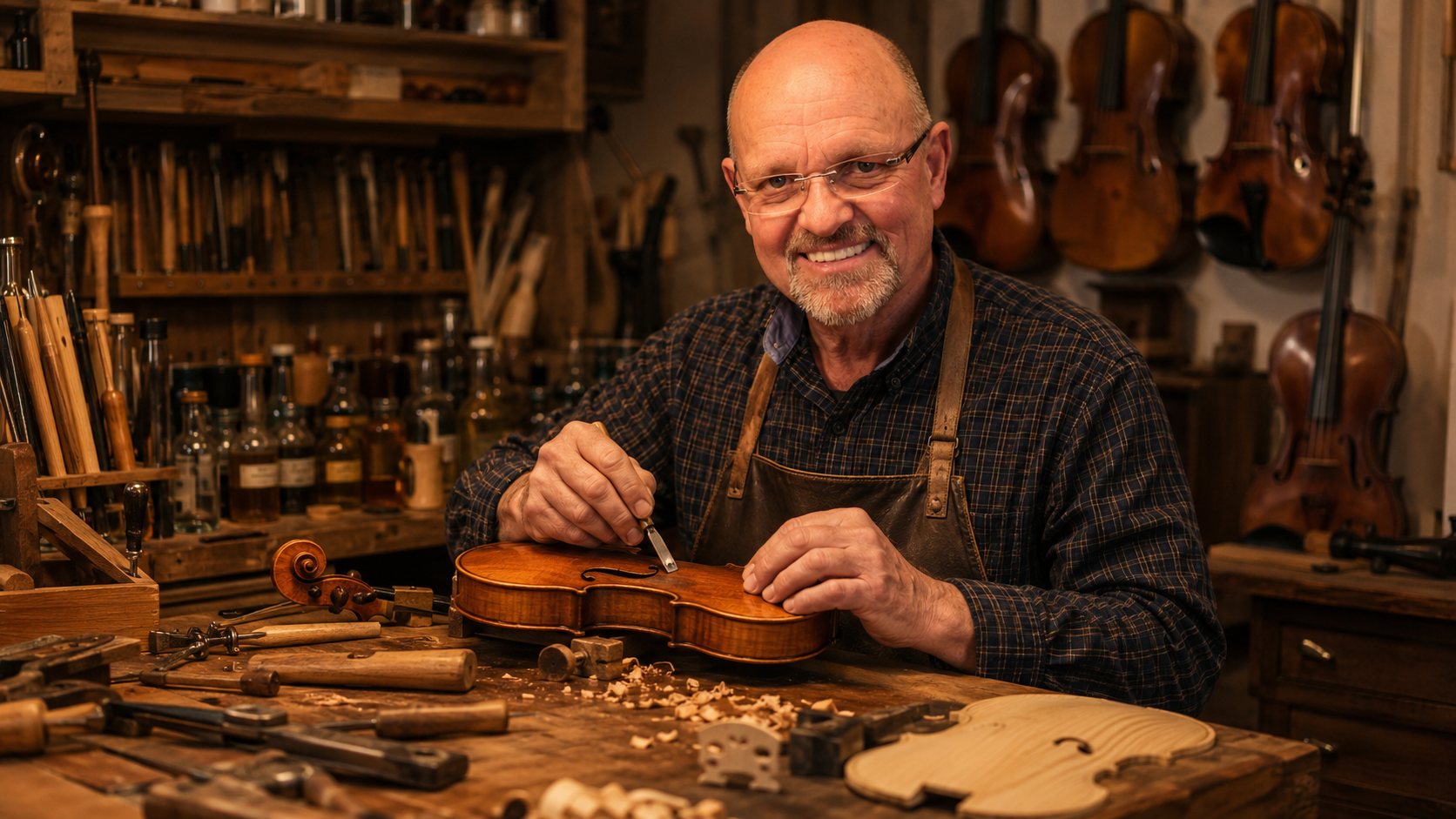
You can spend an afternoon in a dealer's showroom playing thirty violins, hand each one back, and leave no closer to an answer. The problem is not your ear. The problem is that none of those instruments were built for you.
The Myth of the Perfect Violin on the Wall
Every serious player reaches the same wall eventually. The instrument that carried them through conservatory, through regional competitions, through the first professional auditions stops growing with them. The tone that once felt full starts to feel thin in a concert hall. The projection that impressed a teacher disappears behind an ensemble. The violin isn't broken. It has simply reached the ceiling of what it was made to do.
The instinct is to go shopping. To try everything. To hold fifty instruments in fifty showrooms and wait for the one that speaks. But here is what most players are never told: a dealer's instrument is voiced for the showroom, not for you. It is set up to sound impressive in a fifteen-second trial under fluorescent lights. It is not set up for your bow pressure, your vibrato width, your repertoire, or the hall where you perform on Saturday nights.
The violin that is right for you is not the one with the best specs on paper. It is the one that was built, adjusted, and matched to the way you actually play.
This is the gap that professional lutherie exists to close. And it is a gap that most of the instrument market has quietly decided to ignore.
What Matching Actually Means
The word gets used loosely. Dealers talk about matching players to instruments the way a shoe store talks about fit. Try a few, see what feels comfortable, take the one that doesn't pinch. But in the hands of a serious luthier, matching is something fundamentally different. It is a process that begins long before the instrument is finished and continues long after it leaves the bench.
When Hermann Janzen, a master luthier working out of Mission, BC, begins a commission, the first conversation is not about wood species or model choice. It is about the player. How do you bow? Where do you tend to push: at the tip or at the frog? Do you need projection, or do you need warmth? Is your current instrument fighting you in the upper register, or are you losing color in the lower strings? What does your playing ask for that nothing you have tried has yet answered?
Those answers shape every decision that follows. The arching of the top. The graduation. The precise thickness of the plates at every point across their surface. The choice of tonewood, because two pieces of spruce from the same forest can behave entirely differently under the bow. The setup of the finished instrument: string height, soundpost position, the fit of the nut and saddle. Each variable is a dial, and the luthier's job is to turn every dial toward the specific player sitting in the workshop.
This is what separates a handcrafted violin Canada-based players commission from a maker like Hermann from anything available in a retail setting. It is not a matter of price. It is a matter of process.
The Science Behind the Intuition
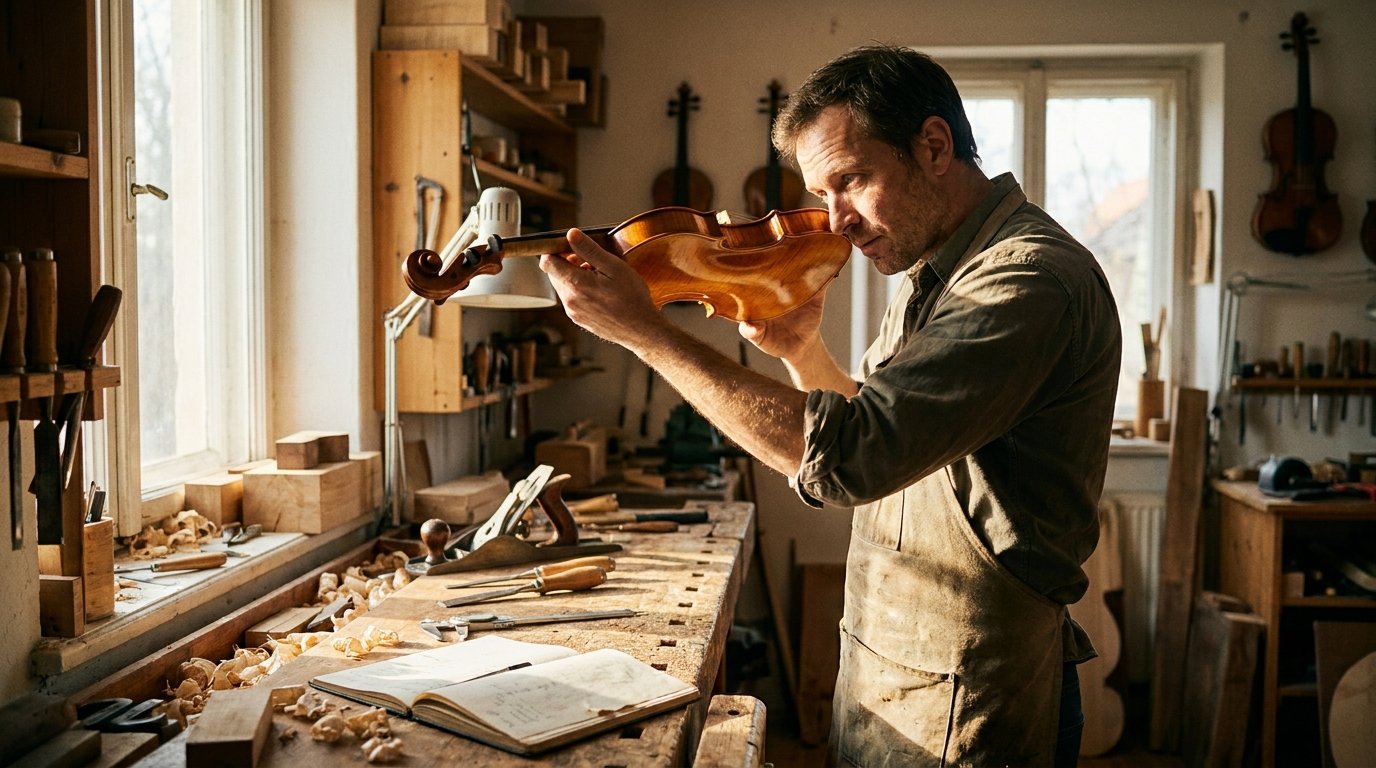
Luthiers speak in a language that sounds almost mystical to outsiders. They talk about tap tones. The sound a plate makes when you knock it gently with a knuckle, before the instrument is even assembled. They talk about flexibility, about how a top wants to move. They hold a carved plate up to the light and read the grain the way a doctor reads an X-ray.
But there is rigorous physics underneath the poetry. The violin's top plate, typically carved from European spruce or its equivalent, is the primary acoustic engine of the instrument. Its thickness at any given point determines how freely it vibrates at specific frequencies. A top that is graduated too thick in the center will produce a powerful but inflexible sound. Too thin, and the instrument blooms but loses focus under pressure. The luthier is tuning a resonant system, and the target frequency profile is not abstract. It is the player's voice.
The back plate, usually maple, reflects and projects the sound the top generates. The choice of maple, its figure, its density, and the angle of its flame, shapes the color and brilliance of the output. A highly figured maple back contributes brightness and projection. A plainer piece contributes warmth and depth. Neither is correct in the abstract. Both might be correct for a specific player.
Then there is the varnish. The chemistry and application of the finish affects how freely the wood vibrates after the instrument is sealed. The great Italian makers, Stradivari and Guarneri del Gesù, understood this. Their varnishes remain studied and debated centuries later. A contemporary maker working in the same tradition is not guessing. He is applying accumulated knowledge about how to protect the wood without strangling it.
Modern Makers and the Old Italian Question
The debate runs through every serious violin forum, every conservatory hallway, every blind listening test that dares to be published: can a modern violin maker vs Stradivarius comparison ever end in favor of the living craftsman?
The answer, increasingly, is yes. Blind tests conducted in recent years have repeatedly found that professional players, given identical conditions, cannot reliably distinguish old Italian instruments from the finest contemporary work. In some tests, modern instruments are preferred. The mythology of the old Italian masters is real. But the mythology has been allowed to do more work than the acoustics justify.
The instruments that become legendary are the ones serious players discovered before everyone else did. And the proof is always in the playing, never in the label.
A player in the professional violin community described a Janzen instrument built as a Stradivarius copy in the tradition of the great Italian models as having a "powerful, brilliant sound." That description did not come from a press release. It came from a musician who played the instrument and put their honest reaction into words in a public forum. That is the kind of proof that matters to the skeptical professional player who has heard every marketing claim and trusts none of them.
Hermann Janzen's work is recognized within the Fraser Valley and Greater Vancouver chamber music community, listed in professional luthier directories, and documented in a MAC Artist Profile. In October 2026, the contemporary violin makers exhibition in New York City will bring together the world's top living craftsmen, and Janzen's work belongs in that conversation. Not because of a credential, but because of what the instruments do under the bow.
What the Restoration Process Reveals
There is a second way to understand how a luthier thinks about matching, and it comes through restoration work. When Hermann takes in an instrument for tonal adjustment or structural repair, he is not approaching it as a technician following a protocol. He is approaching it as a builder who understands why the instrument was made the way it was, what its maker intended, and what the wood is still capable of doing.
A shop repair bench addresses symptoms. A maker-restorer addresses architecture. The difference shows up in the result. A soundpost adjustment made by someone who has graduated hundreds of tops by hand is a different act than the same adjustment made by someone who learned it from a manual. The hands know things the manual does not.
For players who are not yet ready to commission a new instrument, restoration is also the lowest-barrier entry point into the Janzen relationship. Bring in what you have. Let Hermann tell you what it is capable of, and what it is not. That conversation alone is worth the drive to Mission.
The Conversation That Starts Everything
Every Janzen violin begins the same way. Not with wood selection, not with a model choice, not with a price discussion. It begins with a conversation about the player.
If you have been fighting your instrument, feeling like you are pushing for projection that never quite arrives, or searching for warmth that disappears under pressure, or playing music that deserves more than your current violin can give, that conversation is the first step. You do not need to know what you want. You need to describe what is missing. Hermann Janzen has built instruments for players who came to him with exactly that uncertainty, and the process of building toward a specific voice is part of the craft.
The boutique luthier Fraser Valley and Vancouver players have access to in Mission is not a retail experience. There is no catalog, no inventory, no off-the-shelf path. There is a workshop, a craftsman, and the kind of quiet, unhurried attention that a handmade instrument deserves. Players have traveled farther for less. The drive from Vancouver is ninety minutes. The instrument you come back with may be the one you play for the rest of your career.
If you are ready to begin the conversation, reach out to Hermann Janzen directly and tell him about your playing. That is how this starts.